Soil Redox Processes
Rivka Fidel
Learning Objectives
- Identify features of reduction-oxidation processes in soil
- Explain significance of redox features
Importance:
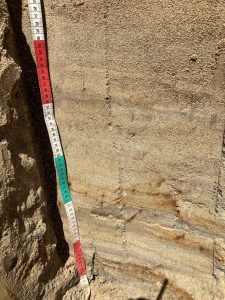
Reduction and oxidation (redox) reactions affect numerous soil processes, ultimately influencing nutrient availability and mobility, microbial activity, soil pH, and even soil color.
Redox processes alter soil’s appearance in ways that help us interpret soil formation conditions. Reduction and oxidation features (redox features, or redoximorphic features) are indicators of important soil conditions, particularly oxygen status. Even in drought conditions, soil redox features can be used to avoid potentially costly issues, like basement or septic system placement in an area with regularly saturated conditions.
Redox Reaction Basics
Reduction reactions occur when an element gains electrons from another element, reducing their charge (making the charge more negative). Oxidation reactions occur when an element loses electrons. To help you remember, you can use the mnemonic “LEO the lion says GER“, standing for:
- LEO: Loss of Electrons is Oxidation
- GER: Gain of Electrons is Reduction
Redox Concepts from Intro Chem
Soil scientists apply redox concepts from chemistry to help understand and predict redox processes in soils. Here are some videos explaining redox reactions and how to interpret them at an introductory level (not specific to soil science):
Note that you would not expect to find many of the chemicals in these videos, like F2 or Mg0, in soil.
Some of the most common elements to undergo redox reactions in soil are iron (Fe) and manganese (Mn). They tend to lose their electrons to elements like O in oxygen gas (O2) and N in nitrate (NO3–).
Both O and N – nonmetal elements that frequently gain electrons, and become “reduced” – are what’s called oxidizing agents, because they help oxidize other elements. Of these, oxygen is the best oxidizing agent found in nature. That is why organisms that use oxygen for respiration are so common.
Metals like Fe and Mn, however, tend to act as reducing agents, because they help reduce the O and N.
Example Redox Reactions
You may have wondered why metals rust, or why you can’t find tiny bits of iron or copper ore lying around in the soil. “Rusting” phenomena are redox reactions! For example, the iron found in iron ore and cast iron pots is Fe0. Fe0 readily donates electrons, as shown in this half reaction:
Fe
0↔ Fe
2++ 2e
–Notice how the Fe
0gave up 2 electrons, which appear in the products. In giving up electrons, the Fe was
oxidized, and developed a 2+ charge. Fe2+ can precipitate with OH- and form green rusts. Or, it can react again, like this:
Fe
2+↔ Fe
3++ e-
Now, you may be wondering where these electrons are going. In nature, oxidation reactions are always paired with reduction reactions, because the electrons must always go somewhere. Half reactions only show half the story! In well-aerated soils, the most common oxidizing agent is O
2gas. It is reduced via this half reaction:
O
2+ 4e- ↔ 2O
2-Here the two oxygens in oxygen gas have accepted 2 electrons each, for a total of 4 electrons.
If we double the first half reaction with iron, and then add it to the one with oxygen, we can write a balanced reaction like this:
2Fe
0+ O
2↔ Fe
2++ O
2-The iron has donated 2 electrons per atom, or 4 total, to the oxygen gas. The oxygen gas develops a -2 charge, and the iron develops a +2 charge. Then, in the presence of water, Fe reacts with water to form green rust:
Fe
2++ 2H
2O ↔ Fe(OH)
2Any Fe
2+in solution can alternatively react again with oxygen like this:
2Fe
2++ O
2+ ↔ Fe
3++ 2O
2-Reduction Features:
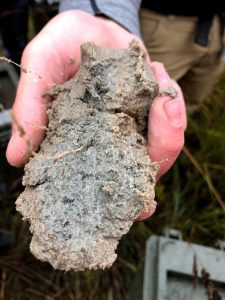
Reduced conditions, shown by the grey colors, indicate a lack of oxygen in that soil area. This is frequently associated with saturated conditions, but additional factors can contribute. Even during a drought, redox colors developed due to regular saturation will still be present, making soil color an important indicator of expected wetness conditions.
A variety of different compounds in soil can be reduced (nitrate, iron, manganese, sulfur), maybe table of reducing energy here?
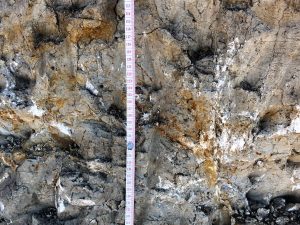
Reduced iron is mobile, meaning it can move in the soil solution until it comes in contact with oxygen.
Oxidation Features:
Key Takeaways
Reduction-oxidation features in soil are important indicators
- Gleyed conditions indicate frequent saturation
- Redox depletions and concentrations indicate a fluctuating water table
License

Copyright © 2023 by Amber Anderson